RESEARCH

Create. Understand. Protect.

Our research spans three connected themes: designing architected materials, understanding how materials and structures respond to complex loading, and evaluating protective systems under impact. Across these themes, we use computational mechanics and experimental evidence to study deformation, failure, and structural performance.

I. CREATE

Architected and Multifunctional Structural Materials

We study how geometry, topology, and connectivity can be used to control structural response. Current work examines architected materials that develop mechanisms such as rotation, buckling, and sequential collapse, with the goal of relating geometric rules to measurable behavior.

One developing direction uses geometric pattern families from Anatolian kilims and related tiling traditions as structured topology spaces. The aim is not decorative inspiration, but a systematic way to connect repetition, symmetry, and connectivity with deformation mechanisms.

Ongoing research. Detailed geometries and design parameters are not posted before publication.

Architected material specimen under compression
Auxetic behavior of a culturally inspired lattice structure.
II. UNDERSTAND

Mechanics of Lightweight Structures under Extreme Loading

Lightweight structures such as thin-walled components, woven fabrics and architected materials respond to impact in ways that quasi-static analysis cannot predict. Under extreme loading, stress waves, large deformations and material rate effects act together. The response becomes sensitive to details that would not matter under slow loading.

We study this class of problems with nonlinear explicit finite element analysis, supported by experimental data where available. Our models range from the yarn scale in woven fabrics to full structural systems.

The purpose of these models goes beyond reproducing a test. We use them to identify which mechanisms control the response, and to explain why one deformation or failure path develops instead of another.

Woven fabric experimental observations and numerical predictions
Response of the Kevlar KM2 fabric under ballistic impact.
III. PROTECT

Protective Structural Systems and Crashworthiness

This theme focuses on the design and performance of protective systems, including roadside safety barriers, combat helmets, and armor plates.

Each application has its own performance measures. In roadside systems, the barrier must contain and redirect the vehicle while limiting occupant risk. In helmets and armor, penetration resistance and deformation behind the impacted surface are important measures of protective performance. Meeting these requirements also involves constraints on weight, dimensions, and material choice.

These problems share one design question: how should a structure carry impact loads and deform so that protection is achieved across different impact conditions, rather than only in a single test?

Crash test and finite element simulation comparison
Response of the Oregon triple-tube bridge rail to a Ford F-250 impact.
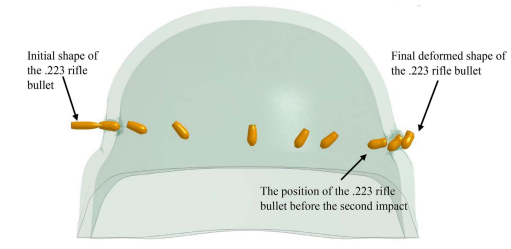
Experimental observation and finite element prediction of helmet penetration under ballistic impact
Response of the Advanced Combat Helmet to rifle bullet impacts.